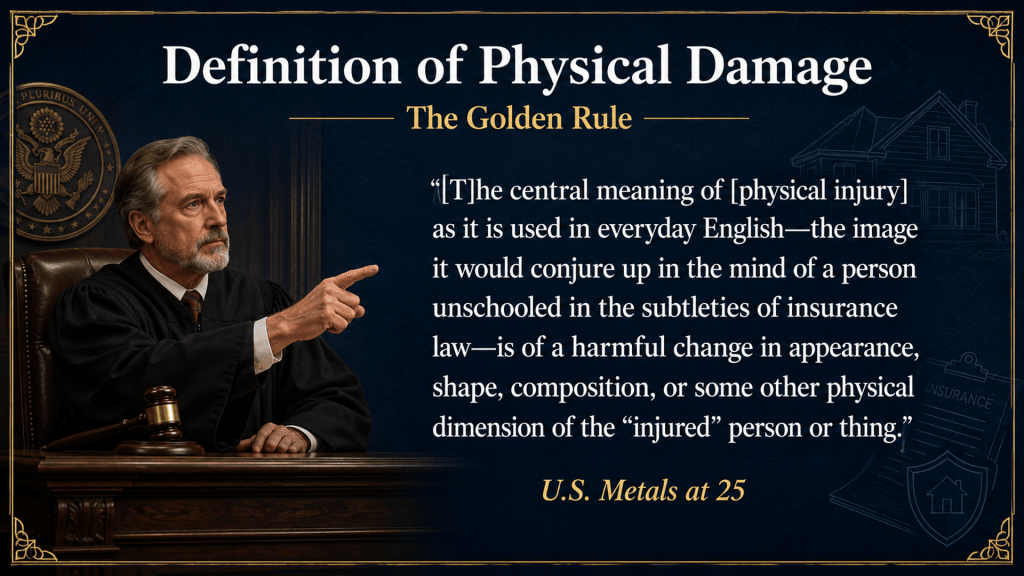
U.S. Metals, Inc. v. Liberty Mut. Grp., Inc., 490 S.W.3d 20 (Tex. 2015)
OVERVIEW: Not all damage is the same. Generally, an insurance policy limits coverage to physical damage or loss to covered property. Often stakeholders involved in the insurance claim confuse intangible and tangible physical damage.
Issue: What is ‘physical injury to property?’
“A thing whose use or function is diminished by the incorporation of a faulty component can fairly be said to be injured, even if the injury is intangible, latent, or inchoate. But if that increased risk amounted to physical injury within the meaning of the CGL policy, then it is difficult to imagine a non-physical injury. Any lessening of property by adding a component would be not only injury but physical injury. The policy’s limitation of coverage to damages from physical injury necessarily implies that there can be nonphysical, non-covered injuries. Otherwise, the requirement that injury be “physical” would be superfluous. To give “physical” its plain meaning, a covered injury must be one that is tangible.”
Consider: What is a term used to denote the lessening or diminished value of a component, system or property that does not rise to the level of loss of use or tangible physical damage? (wear and tear, depreciation)
Issue: Faulty Workmanship
“Faulty workmanship that merely diminishes the value of the home without causing physical injury or loss of use does not involve ‘property damage.’ Faulty workmanship occurs not at the time the damage manifests (when it is discovered or discoverable nor when the plaintiff is exposed to the agent that will eventually cause the damage (when it is installed, presumably). . . [O]ccurred means when damage occurred, not when discovery occurred. . . [A] defective product that causes damage is not an occurrence until the damage actually happens.” U.S. Metals, Inc. v. Liberty Mut. Grp.,Inc., 490 S.W.3d 20, 23-27 (Tex. 2015)(internal cites omitted)
Issue: Prematurely Aged
Prematurely aged is a form of diminished value that is not considered property damage. As the Texas Supreme Court noted in 2007, “ . . . faulty workmanship that merely diminishes the value of the home without causing physical injury or loss of use does not involve “property damage.” Lamar Homes, Inc. v. Mid-Continent Cas. Co., 242 S.W.3d 1, 6 (Tex. 2007)
Issue: Is Wear and Tear Tangible Injury to Property?
Wear and tear, defective components, and faulty workmanship can shorten the life of a roofing system. But until the roofing system fails (it no longer sheds water because it’s worn out), there is no occurrence of tangible physical damage. These conditions represent intangible damage if there’s only a risk the life span of the roofing system may be shortened. This ‘risk’ is not a certainty until it actually happens. (Leaks from U.S. Metals’ flanges never caused injury because ExxonMobil replaced them to avoid any risk of injury. The court held Exxon Mobil’s diesel units were not physically injured merely by the installation (and associated risk) of U.S. Metals’ faulty flanges).
Issue: The Concurrent Causation Doctrine (Not an issue for appraisal)
An insured has the initial burden of proving coverage, which includes proving the damage occurred during the policy period. Included in this doctrine is the burden to segregate covered and non-covered damage.
“When . . . covered and non-covered perils combine to create a loss the insured is entitled to recover only that portion of damage caused solely by the covered peril.”
If the doctrine is applicable, the insured is obligated to present “some evidence” upon which the jury can allocate the damage attributable to the covered peril.
A practical example of where you might encounter this doctrine is when an insurer denies a claim asserting pre-existing damage.
Problem: Pre-Existing Wear and Tear
Answer: Pre-existing wear and tear is ordinarily not competing physical damage that must be segregated from storm damage. The exclusion itself still operates through the policy’s physical-loss gatekeeper: the insurer must identify physical loss, damage, or injury caused by wear and tear.
Most ordinary wear and tear to a roofing shingle never gets that far. Granule loss, aging, brittleness, oxidation, or general deterioration may describe the shingle’s condition, but unless that condition has manifested in a harmful change to the component’s function—most importantly, its ability to shed water—it is not pre-existing physical damage.
If the shingle still performs its intended water-shedding function, the wear and tear is a condition, not competing physical damage. Its effect is addressed through depreciation, not segregation under the concurrent causation doctrine.
General Concept: Insurance protects against fortuitous risks. Wear and tear is expected, not fortuitous. More importantly, the existence of wear and tear does not by itself establish an excluded physical loss. Before the wear-and-tear exclusion can matter, the insurer must first pass the same gatekeeper applicable to exclusions generally: What physical loss, damage, or injury did the excluded cause actually produce?
Thus, an old or worn shingle is not necessarily a physically damaged shingle. If it continued to shed water before the storm, ordinary age and wear did not manifest a functional failure of that component. There is therefore no pre-existing physical damage to segregate from newly caused storm damage.
Problem: Multiple Storm Events
General Concept: Insureds have the burden of presenting “some evidence affording the jury a reasonable basis on which to allocate the damage [between storm events]”
General Concept: 1) The insured’s burden is ‘light,’ and 2) can be met by expert testimony showing the identified damage is solely the result of the storm at issue [the date of loss] (evidence that 100% of the loss is from the single event — date of loss).
Why is this Important?
Insurers are aggressively asserting and relying on the concurrent causation doctrine to avoid paying claims. Contractors, at the outset of the claim, must always be mindful of whether the damage found and claimed is ‘new damage’ and be prepared to segregate old damage (if any) from new damage. Note: Appraisal does not solve this issue. Appraisers do not distinguish between old and new hail, water, fire, or wind damage.
Disclaimer
This article is for informational purposes only and not for the purpose of providing legal advice. You should contact your attorney to obtain advice with respect to any particular issue or problem. Use of and access to this article or any of the e-mail links contained within the site do not create an attorney-client relationship between Thomas W. Hamrick and the user or browser. The opinions expressed in this article are the opinions of the individual author and may not reflect the opinions of other lawyers.

 Coffee with Tom