Defective but Functional Tiles
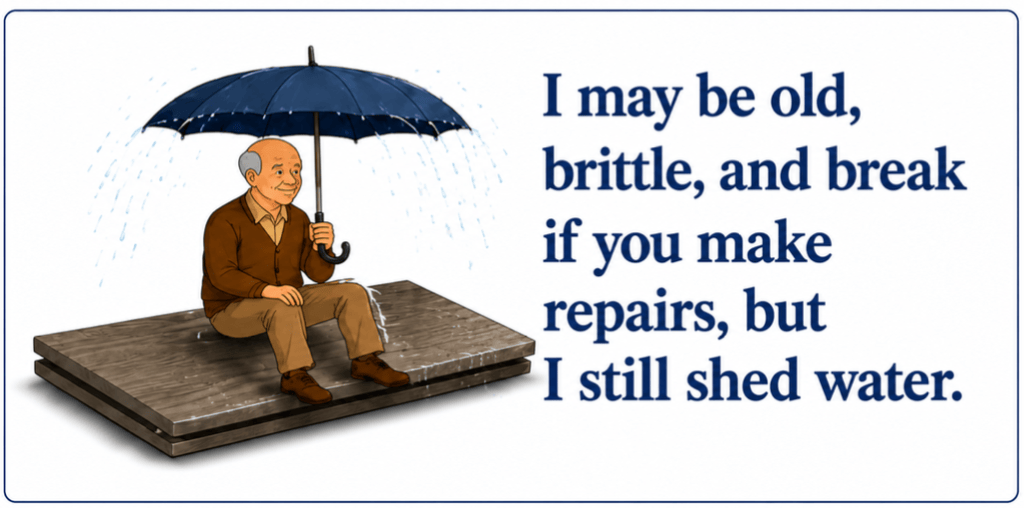
Like many of us, All Saints Catholic Church purchased an insurance policy to protect its property. Unfortunately, the church’s roof turned out to be made with Hardi-Slate tiles that were later alleged to be defective because they were prone to absorb excessive moisture and deteriorate, leading to breakage and premature failure. Even so, All Saints maintained that before the hailstorm the roof performed as intended: it shed water.
Then the hail came. The storm damaged some of the tiles, and the roof began leaking. All Saints made a claim. Although the insurer maintained that the Hardi-Slate tiles were defective, it nevertheless paid to replace the tiles actually damaged by hail. That should have been straightforward. It wasn’t. According to All Saints, even though the roof had never leaked before the storm, the remaining tiles had become so brittle that replacing the hail-damaged tiles would cause surrounding, otherwise undamaged tiles to break during the repair. In All Saints’s view, the only practical way to repair the covered hail damage was to replace the entire roof.
When the parties could not resolve their disagreement, All Saints filed suit. It lost on summary judgment and appealed to the Dallas Court of Appeals. On appeal, the court identified two issues that would determine whether All Saints was entitled to recover the cost of replacing the entire roof.
Here’s What Happens When You Conflate a Hazard with Physical Damage
The court began with a familiar rule: “Under the doctrine of concurrent causation, where covered and non-covered perils combine to create a loss, the insured is entitled to recover only that portion of the damage caused solely by the covered peril.” That sounds simple enough. But it makes the word “peril” important. Some basic background is helpful.
The insurance bargain begins with the transfer of risk from the insured to the insurer. As the Supreme Court explained, “The transfer of risk from insured to insurer is effected by means of the contract between the parties-the insurance policy-and that transfer is complete at the time that the contract is entered.” Union Labor Life Insurance Co. v. Pireno, 458 U.S. 119, 130 (1982). The Court further explained that “the insurance policy defines the scope of risk assumed by the insurer from the insured.” Id.
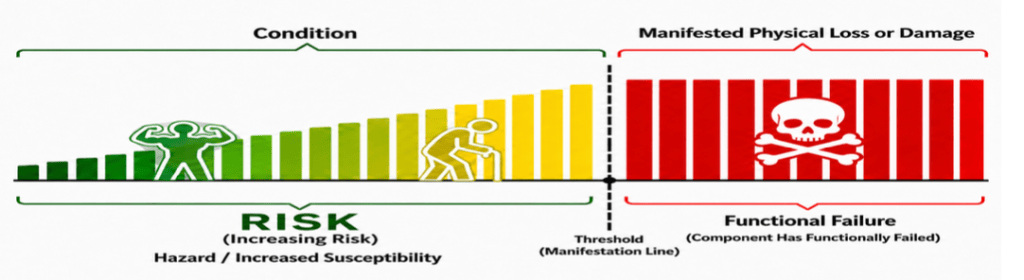
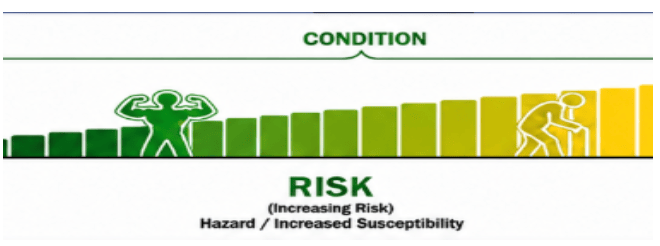
Further, insurance terminology distinguishes between the thing that causes a loss and a condition that merely makes a loss more likely. A peril is a cause of loss: for example, fire, windstorm, or collision. A hazard is a condition that increases the probability of loss.1 When you put it all together, a condition is a type of hazard to the property that has not manifested physical loss or damage. Because it is neither covered physical damage nor excluded physical damage under the policy, the condition or hazard remains part of the risk transferred to the insurer when the policy is issued.
That distinction matters in All Saints. The hail at issue in the case was plainly a peril: it struck the roof and physically damaged some of the tiles. But what about the brittleness, deterioration, wear and tear, and latent defects associated with the remaining tiles? Did any of those conditions actually produce physical loss or damage to the tiles? Or were they merely pre-existing conditions of the tiles: hazards that made additional damage more likely when the covered repairs were performed?
The answer matters because the concurrent causation doctrine begins with competing perils that cause physical loss. If one side of the equation is merely a condition or hazard that has not manifested physical loss or damage, there is no competing physical loss to segregate. While a hazard could be described as non-covered intangible loss or damage, that does not transform a condition into tangible physical loss; rather, it is part of the risk transferred to the insurer when it collected the premium and issued the policy.
What is Physical Damage and How is it Different from Intangible Damage
The court had no difficulty identifying the covered peril: hail. The harder question was identifying the competing non-covered physical loss. The opinion pointed to wear and tear and latent defects in the Hardi-Slate tiles. But the roof shed water before the storm. Although the remaining tiles were brittle and susceptible to breaking during repair, they continued to perform their intended function.
If this discussion of physical damage, intangible damage, functional loss, conditions, hazards, and perils sounds confusing, there is a good reason. All Saints never discusses these concepts or uses the word “physical” at all. The opinion speaks instead in a vocabulary that is familiar but imprecise: “damage,” “damaged property,” “loss,” “wear and tear,” “latent defects,” and “prematurely-aged” tiles. It describes the non-hail-damaged tiles as unable to “withstand the repairs without breaking,” and recounts All Saints’s position that the remaining tiles were “functioning properly.” Ultimately, the court concluded that “part of the loss of the roof” resulted from hail, while “part of the loss” resulted from wear and tear and latent defects.
That language makes it easy to slide from one legal category into another without noticing the transition. “Defective” can describe a condition, another way of identifying a hazard whose risk was transferred to the insurer. “Prematurely aged” can describe the same thing. A tile that cannot withstand repair without breaking may likewise present a hazard: a susceptibility to future damage. And “functioning properly” points in the opposite direction. The component has not yet suffered the functional loss being discussed. The problem is that ordinary words like “damage” and “loss” can encompass all of those ideas in casual usage. In insurance law, they do not necessarily mean the same thing.
All Saints Has Not Aged Well
There is another reason All Saints is difficult to read today: it has not aged particularly well. The opinion was decided in 2008, and Texas law on the subject did not stop developing there. In the years that followed, the Texas Supreme Court decided several important cases addressing concepts that sit directly beneath the reasoning in All Saints, including what constitutes physical injury and why the risk of future damage from a defective component is not itself the kind of damage covered by a policy requiring physical damage as a predicate.
What U.S. Metals Adds to the Story
U.S. Metals, Inc. v. Liberty Mutual Group, Inc. begins where All Saints never did with the word “physical.” The Texas Supreme Court recognized that the policy did not cover every injury; it covered only “physical injury.” That limitation had to mean something. If an increased risk of harm were itself enough to constitute physical injury, the Court reasoned, the word “physical” would be superfluous. Accordingly, “[t]o give ‘physical’ its plain meaning, a covered injury must be one that is tangible.” U.S. Metals, Inc. v. Liberty Mutual Group, Inc., 490 S.W.3d 20, 24–25 (Tex. 2015).
That distinction led the Court directly to intangible injury. Significantly, the Court spoke in terms of components, use, function, and risk:
“A thing whose use or function is diminished by the incorporation of a faulty component can fairly be said to be injured, even if the injury is intangible, latent, or inchoate.” Id. at 24.
The faulty component could certainly harm the larger property in an intangible sense by increasing the risk associated with its operation and reducing its value. But the Court rejected the proposition that increased risk alone amounted to physical injury. Otherwise, it explained, “it is difficult to imagine a non-physical injury.” Id. at 24–25.
The Court then addressed what physical injury actually requires. Quoting Eljer I, it described the central meaning of physical injury as a “harmful change in appearance, shape, composition, or some other physical dimension” of the injured property. Id. at 25. The Court ultimately embraced that distinction, holding that physical injury requires “tangible, manifest harm” and does not arise merely because a defective component has been incorporated into a product or system. Id. at 27.
And then comes an analogy that sounds almost as though it were written for All Saints. In explaining the difference between a dangerous condition and manifested physical injury, the Court quoted Eljer I:
“The ticking time bomb, in contrast, does not injure the structure in which it is placed . . . until it explodes.” Id. at 25.
Equally important, the ticking time bomb represents the very risk transferred to the insurer when the All Saints policy was issued. Until the defective Hardi-Slate tile manifests physical loss or damage, it remains a hazard: a risk of future harm, not competing non-covered physical damage or loss. US Metals’ discussion of defective plumbing makes the point concrete. A plumbing system could contain a defective component for years before it leaked. The defect created the risk; the leak was the manifestation of physical injury. In U.S. Metals itself, the defective flanges never caused injury because ExxonMobil replaced them “to avoid any risk of injury.” Id. at 26.
Now return to the Hardi-Slate tiles. They were allegedly defective, prematurely aged, and brittle. They might break when disturbed during repair. But the remaining non-hail-damaged tiles, prior to repair, were still “functioning properly.” The alleged brittleness may have increased the risk that those tiles would later fail, just as the ticking time bomb presented the risk that it would someday explode. But the risk of future failure is not the failure itself.
U.S. Metals tells us that physical injury requires a harmful change and tangible, manifest harm. When the property at issue is a component designed to perform a particular function, that harm manifests when the harmful change causes the component to fail in its intended function. Put more simply, in a first-party property claim, a structure is made up of components. Each component has an intended use or function. A harmful change to a component that causes it to fail in that intended function is physical damage. A condition that merely creates the risk of future functional failure is not.
To the extent All Saints is read to support the proposition that the mere incorporation of a defective component constitutes physical loss or damage, that proposition is contrary to Texas law. Texas does not follow the incorporation theory. U.S. Metals, Inc. v. Liberty Mutual Group, Inc., 490 S.W.3d 20, 24-25 (Tex. 2015). Additionally, All Saints does not support the proposition that a mere condition of the property, a transferred hazard, constitutes a non-covered peril or physical loss, nor does such a condition require segregation.
Finally, as discussed in the next section, All Saints does not support the proposition that the court found the brittle shingles constituted pre-existing physical damage. The court held that the hail- damaged tiles were recoverable, and the insurer in fact agreed to pay for those tiles. Had the defective condition itself constituted pre-existing physical damage, the court could not have treated subsequent hail damage to those same tiles as a wholly new covered loss without addressing and segregating the pre-existing physical damage, which would have applied to all of the Hardi-Slate tiles.
In sum, the defective tiles were a hazard transferred to the insurer. Without a showing that the hazard had manifested physical loss or damage, the insurer cannot avoid the risk associated with that condition.
The Second Issue: How Much Is Damaged Versus How Much Needs to Be Replaced
The second issue addressed by the court in All Saints begins with a proposition that sounds almost self-evident: an insurer should only have to pay for property damaged by a covered peril. United National had already paid $83,816 to replace the Hardi-Slate tiles it determined were damaged by hail. All Saints sought the cost of replacing the entire roof because the hail-damaged tiles could not be spot repaired without breaking the surrounding tiles.
Unfortunately, the All Saints court did not have the benefit of the Texas Supreme Court’s later decision in State Farm Lloyds v. Johnson, 290 S.W.3d 886, 891 (Tex. 2009). In Johnson, State Farm emphasized on appeal that it was disputing “not just which shingles were damaged, but which were damaged by hail.” But the Texas Supreme Court noted that the record did not conclusively establish that the parties’ dispute was “solely about how much of the roof was damaged rather than how much needs to be replaced.” Id.
The distinction matters. The question is not only which shingles were damaged by hail, or even how much of the roof was directly damaged. The separate question is how much of the roof must be replaced to properly repair that covered damage. As the Court explained, “[s]ometimes it may be unreasonable or even impossible to repair one part of a roof without replacing the whole.” Id.
The All Saints court approached the problem differently. It reasoned that the hailstorm had damaged some tiles, but not all of them, and emphasized that the remaining tiles were still “functioning properly” after the storm, implying that there was no need to replace components that were still functioning. From there, the court stated the proposition that drives the remainder of its analysis: United National was obligated to pay for “the tiles damaged by the hailstorm-and those tiles only.”
At first glance, there is nothing controversial about saying an insurer only covers physical damage caused by a covered peril. The problem lies in what the court does with that proposition. All Saints was not claiming that hail physically damaged every tile on the roof. Its position was that the covered hail damage could not be repaired by replacing only the hail-damaged tiles because attempting that repair would break the remaining tiles. The question, therefore, was not simply which tiles hail damaged. The question was what work was required to properly repair the tiles that hail did damage. All Saints’ position, unbeknownst to the court, exactly mirrored the Texas Supreme Court’s analysis a year later.
Because the All Saints court never separately asks whether the hail-damaged tiles could actually be replaced without physically damaging the surrounding roof, it treats the identification of the directly damaged tiles as the answer to both questions: what hail damaged and what the insurer was required to replace. Johnson later makes clear that those are not necessarily the same question.
Things to Consider:
Rule 1: Transferred Risk

A peril is a cause of loss: for example, fire, windstorm, or collision. A hazard is a condition that increases the probability of loss. A condition is never considered physical damage. The hazard is a risk that is transferred from the insured to the insurer at the time the policy is issued.
Rule 2: Conditions
If the condition of a component manifests physical damage it is no longer a condition—it becomes physical damage that it is either covered or excluded under the policy.
Rule 3: Intangible Damage
No Texas First-Party Property Policy covers or excludes ‘damage.’ The predicate is ‘physical damage’—and requires evidence of a component’s functional failure. A component’s increased risk of functional failure is ‘intangible’ damage and does not meet the physical damage threshold.
Rule 4: General descriptions of damage are meaningless.
Terms such as “damage,” “damaged property,” “loss,” “wear and tear,” “latent defects,” “brittle,” and “prematurely-aged” do not answer the core question: did the component fail to perform its intended function?
In All Saints, the relevant inquiry should not have been whether the non-hail-damaged tiles were defective, brittle, or susceptible to future failure. The question should have been whether those tiles, after the hailstorm, continued to perform their intended function, namely, shedding water.
Brittleness, unless it manifests as an inability of the tile to perform its intended function, is simply a condition. The analysis begins with two questions:
1. Identify the component’s intended function.
2. Determine whether the component has manifested physical loss or damage, meaning the component has functionally failed.
A component may have more than one intended function. Physical loss or damage depends on whether the component has failed in the function relevant to the claimed loss.
Secundum Quid: When a True Rule Becomes Misleading
It is doubtful that any well-informed lawyer in the first-party property realm would find the concepts discussed in this article novel or groundbreaking. However, adjusters on both sides, appraisers, and other professionals involved in the first-party property claims process also encounter these issues in the field, from something as simple as when “damage” is not physical damage under the policy to determining when damage must be segregated between perils. Unfortunately, these claim professionals are often provided with summaries of the concepts that do not tell the whole story.
For example, many are told:
When covered damage (hail/wind damaged shingles) combines with non-covered damage (old brittle shingles) to require complete roof replacement, the insured is only entitled to recover that portion of the roof replacement cost related solely to the covered damage. And the burden to allocate between covered and non-covered damage is on the insured.
The statement regarding the treatment of old brittle shingles is sometimes accurate and relevant only in select situations. It is inaccurate, however, if the old brittle shingles have not manifested physical loss or damage. Without the qualification, the statement is misleading. The same applies to the duty to segregate. Absent a showing that the brittle shingles have manifested physical loss or damage, no such duty exists.
Secundum quid means “according to something” or “with a qualification” and speaks to one of the purposes of this article: be ever mindful that a proposition that is true only when certain qualifications are present should not be treated as universally true when those qualifications are absent.
Just a thought.
Disclaimer: This article is for general informational purposes only and does not constitute legal advice. Every claim is different. For questions about your specific situation, consult a qualified attorney.
Thomas W. Hamrick, Senior Counsel, DFW Area, Texas (214) 396-7676

 Coffee with Tom